

As soon as you hear the word ‘virus’, the picture of a harmful, small, round creature probably engulfs your mind, as you probably think of ways to safeguard yourself from it. But what if I told you that these could possibly be the next solution to curing the world’s leading cause of death: cancer! Shocking right? Actually, not quite.
 Oncolytic Viruses (OVs) have been in development for over a century. In the 20th century, a reduction in the number of tumor cells was found in a leukemic patient who was also simultaneously infected with a viral disease. This led to further investigation that eventually concluded that viruses were the reason for the reduction in tumor cells! This was a precious discovery that sparked new hope in the sector of immunotherapy. After conducting research on other types of naturally occurring viruses, some results turned out to be positive, while the rest were all negative. Back in the day, there weren't many tools which could be used to investigate further, so interest in this topic had died down. However, today, thanks to technology, genetic engineering has helped rekindle this hope that remained in OVs.
With the help of this, it has become possible to modify the genetic material of viruses, creating genetically engineered viruses that have been enabled to become more specific to targeting and killing tumor cells. Both DNA and RNA viruses were modified accordingly and clinical trials took place that led to further growth in this treatment method.
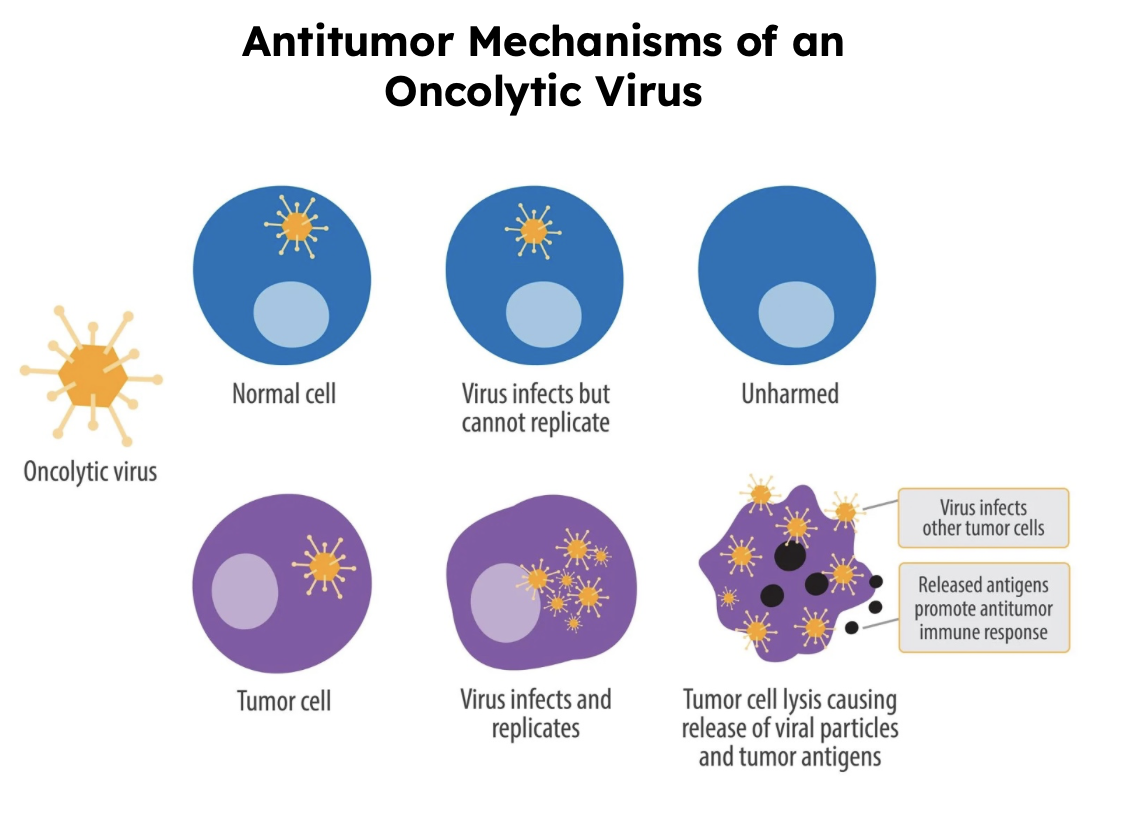
But, how do these Oncolytic Viruses even operate? Their mechanism is simple: targeting cancer cells by inducing direct cytotoxicity in them as well as triggering the patient’s immune system causing an immune-mediated antitumor response. By activating the immune cells, OVs help in stimulating innate immunity against cancer. The targeted tumor cells die via oncolysis, but the way these cells are infected is determined by the type of virus infecting these cells. OVs aim to disrupt the protein synthesis of tumor cells, while replicating themselves and forming progeny viruses which are eventually released through lysis of the tumor cell. Another interesting fact is that they can cause the tumor to weaken by interfering with the blood supply to the tumor. This method can therefore be considered more advantageous as they do not affect other surrounding non tumor cells and tend to have lesser side effects than the conventional chemotherapy.
However, some challenges remain imminent. Trying to implement such therapy that has only been used in lab controlled environments, to a real life clinical scenario possesses many concerns related to its safety. Additionally, what is the guarantee that the immune system of the patient won't attack the OV before it even reaches its destination? Furthermore, if the patient develops antivirus immunity, the effectiveness of the treatment significantly reduces too. Several complications can arise pertaining to the tumor microenvironment that can also hinder the replication of OVs.
But, despite these setbacks, numerous strategies are being implemented to improve the efficacy of OVs. Many new Biotech companies have emerged such as Amgen, which specialise in OV development. Amgen managed to come up with the first FDA approved oncolytic virus therapy, Imlygic, which was obtained from a modified herpes simplex virus, T-VEC. This was directly injected into the tumor and was used to treat metastatic melanoma. Hence, this method of immunotherapy has a lot of scope, can be used on a wide range of malignancies and can complement other immunotherapeutic treatments that are ongoing.


