

Imagine a wooden stick. Now imagine tying a string to one end of the stick, pulling it extremely tight and tying it to the other end. The string almost completely loses mobility, right?
That’s what happens to the actual SPINE of someone with Tethered Spinal Cord (TSC) - the spinal cord - a bunched set of nerves - are taut bound to the spine (bone).
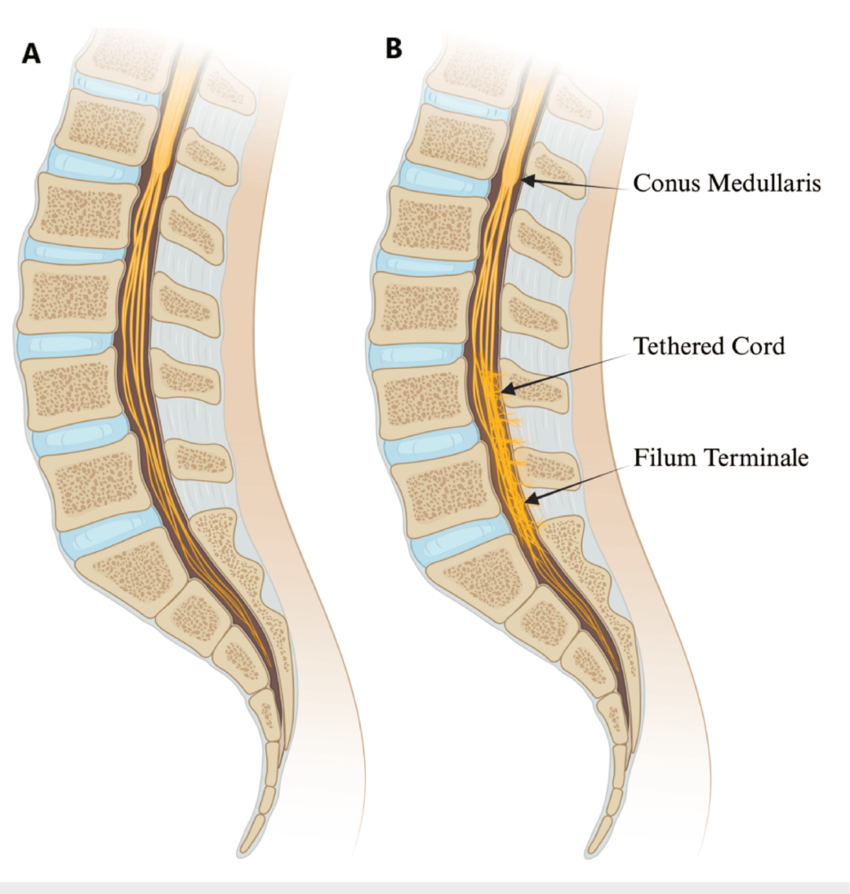
Now why’s that a big deal?
It’s really essential for the spinal cord to be able to bend and move in accordance to the tissues and muscles that surround it, especially in our Head-to-Tail axes, for more than one reason:
Protection: Being able to bend is actually one of the key mechanisms, apart from cerebrospinal fluid and dura mater, that prevents damaging the spinal tissues - as the body requires to turn and bend. A rigid spine would snap early on, leading to extensive pain amidst more pressing issues.
Preventing compression: Flexibility ensures that the roots of our nerves are mobile throughout the vertebral canal, preventing the nerves themselves from being compressed or pinched.
Reform: Upon physical stress, the elastic nature of the spine allows it to come back to its original shape - not deformed.
Maintaining nerve function: It is super important that nerve signals finally reach the intended effector from the Central Nervous System - and without a mobile, or at least elastic spinal cord, these signals are severely hindered.
TSC basically limits a patient’s body’s ability to do all the above things. TSC is a rare neurological disorder, and its effects are drastic - often leaving patients unable to control basic movement and muscles. The affixed spine can cause sensory and motor neurones to send haywire impulses, and can result in reduced blood flow to parts of the body (called Ischemia) - due to unusual growths around the spine. Even systems in the body that are generally considered involuntary, or ‘automatic’ - such as bladder/bowel movement - can become dysfunctional.
As the effects are very wide-ranging and generally dependent on the exact segment of the spinal cord that is tethered to the spine, it’s crucial we discuss a technological solution that helps overall - helping stimulate effectors across the body that can be modified to fit each patient’s specific needs - Neuromodulation.
The word sounds fancy, but the concept is quite often compared to a regular ‘pacemaker’. Neuromodulation is a therapeutic technology that has a simple yet extremely effective process - once implanted into the affected region, it sends short and well-controlled electric impulses to the affected part of the body, helping stimulate activity. Whether it be used before or after surgery, neuromodulation helps strengthen areas receiving weak impulses, prevents haphazard pain signals from really being registered by the brain, and overall improves autonomic systems.
After untethering surgeries, or even to control pain during TSC, neuromodulation can be a pretty invasive technology, but that ultimately depends on which region of the body has been pressurised (which relies on which section of the spine was tethered). In peripheral areas, surgeries to implant the signal generator are simple procedures, but areas that are deeper within or more sensitive can require extensive surgeries.
In conclusion, TCS is a rare but severe disorder that leaves its patients needing all the support they can get. With neuromodulation, patients receive this support - and are pushed a step closer to rehabilitation. Yet this decision ultimately depends on the patient, just how much this condition has affected their living standards, and just how much faith they put into the procedure.
One fact that remains unwavering though - neuromodulation techniques stand strong as one of the many technological advancements that have helped improve the lives of those in need.


